Environmental Protection


Use of Energy Resources
Tung Ho Steel has introduced ISO 50001 Energy Management System to continue monitoring the changes in energy usage at our works. The total energy use of the Headquarters and three Works in 2025 amounted to 5,786,046 GJ, including 3,353,463 GJ from purchased electricity from Taipower, 758,780 GJ from purchased renewable energy from Tung Kang Wind Power Corp. and other external units, and 1,673,803 GJ non-renewable fuel. No renewable fuel was used, and the proportion of renewable energy use accounted for 13.1%note1.
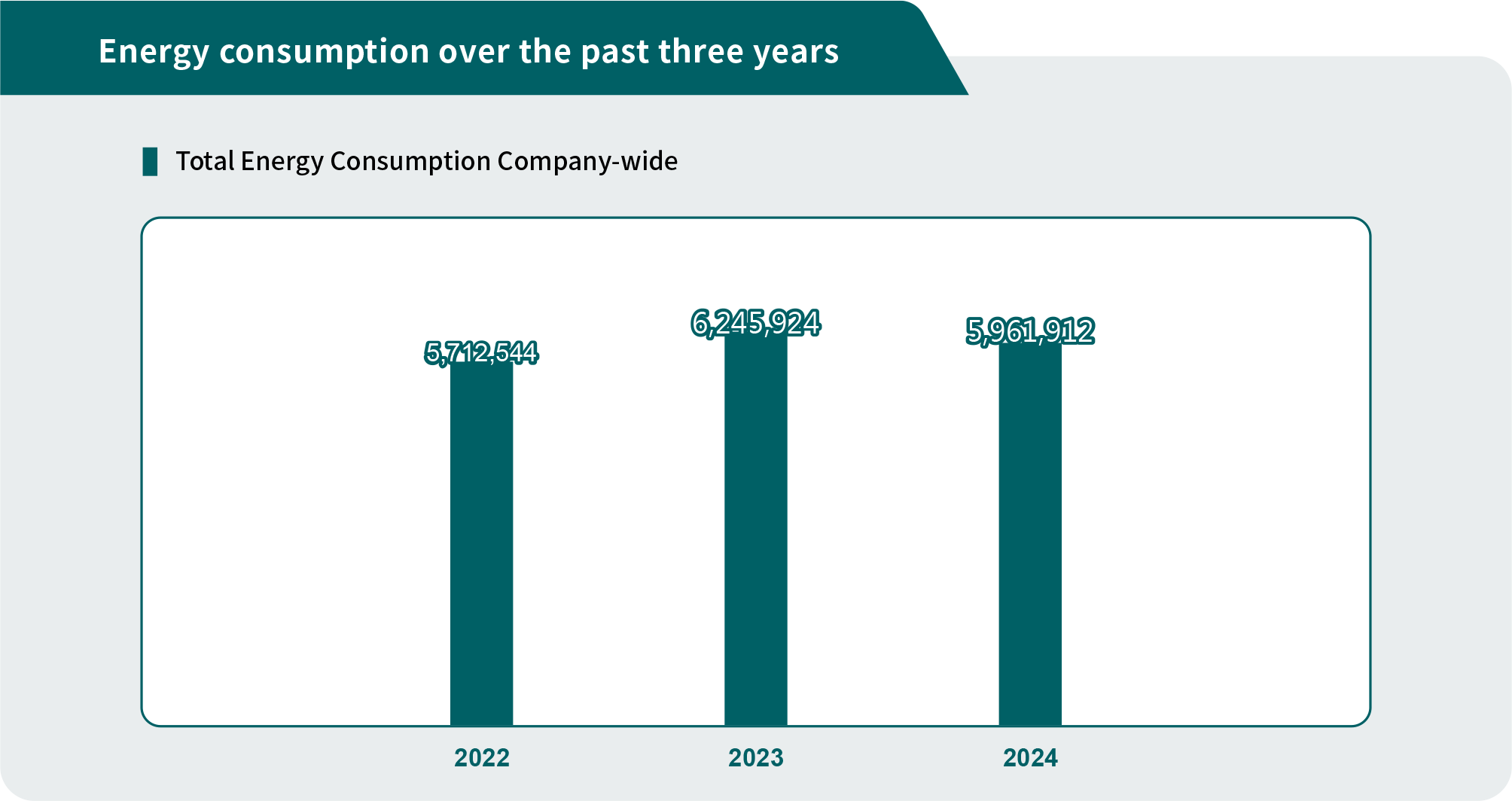
1. Renewable energy usage ratio = Renewable energy purchased from Tung Kang Wind Power Corp. / Total energy consumption
2. Scope of energy calculation: Head Office, Taoyuan Works, Miaoli Works, and Kaohsiung Works.
3. Standards, methodology, assumptions and/or other calculation tools used: The energy consumption amount all came from estimates in the receipts or the monthly natural gas consumption statement and material sheet &AS400/ checklist of changes in material inventories by material part number, and there were no estimated values.
4. Energy use has been converted into GJ (1 GJ=109 joules)
5. Conversion coefficients of calorific values of various energy sources: In 2022 and 2023, 1 kWh = 3,600 KJ; 1 L of gasoline= 32,635.2 KJ (7,800 kcal); 1 L of diesel = 35,145.6 KJ (8,400 kcal); 1 L of liquefied petroleum gas = 27,779.4 KJ (6635 kcal). 1 m3 of natural gas in Taoyuan Works = 9,000 kcal; 1 m3 of natural gas in Miaoli Works =8,000 kcal; 1 m3 of natural gas in Kaohsiung Works-Jiaxing = 8,848 Kcal; 1 m3 of natural gas in Kaohsiung Works-Daye = 8,847 kcal. In 2024, Kaohsiung Works- Jiaxing and Kaohsiung Works-Daye made the following adjustments: 1 L of gasoline= 31,857.36 KJ (by referring to the lower calorific value of automotive gasoline=7,609 kcal/L for 2024 announced by the Ministry of Environment on February 13, 2025); 1 L of diesel = 36,182.33 KJ (by referring to the lower calorific value of automotive diesel= 8,642 kcal/L for 2024 announced by the Ministry of Environment on February 13, 2025).
Greenhouse Gas Inventory
To cope with global warming and effectively mitigate the impact brought by climate change, Tung Ho Steel has been actively promoting energy conservation and carbon reduction. The ISO 14064-1 organizational GHG inventory system is introduced, and the GHG emissions are calculated by identifying emission sources, establishing activity intensity data, emission data, and setting up relevant management procedures for GHG emissions.
The GHG emissions of the Company can be divided into direct emissions (Scope 1) and indirect GHG emission from the use of purchased electricity (Scope 2). The inventory of Scope 3 conducted included upstream and downstream transportation and distribution, employee commuting, business travel, transportation of customers and visitors, fuel and energy related activities, waste generated in operations, downstream leased assets, and investments, covering items in Category 3 to 6 (Scope 3).
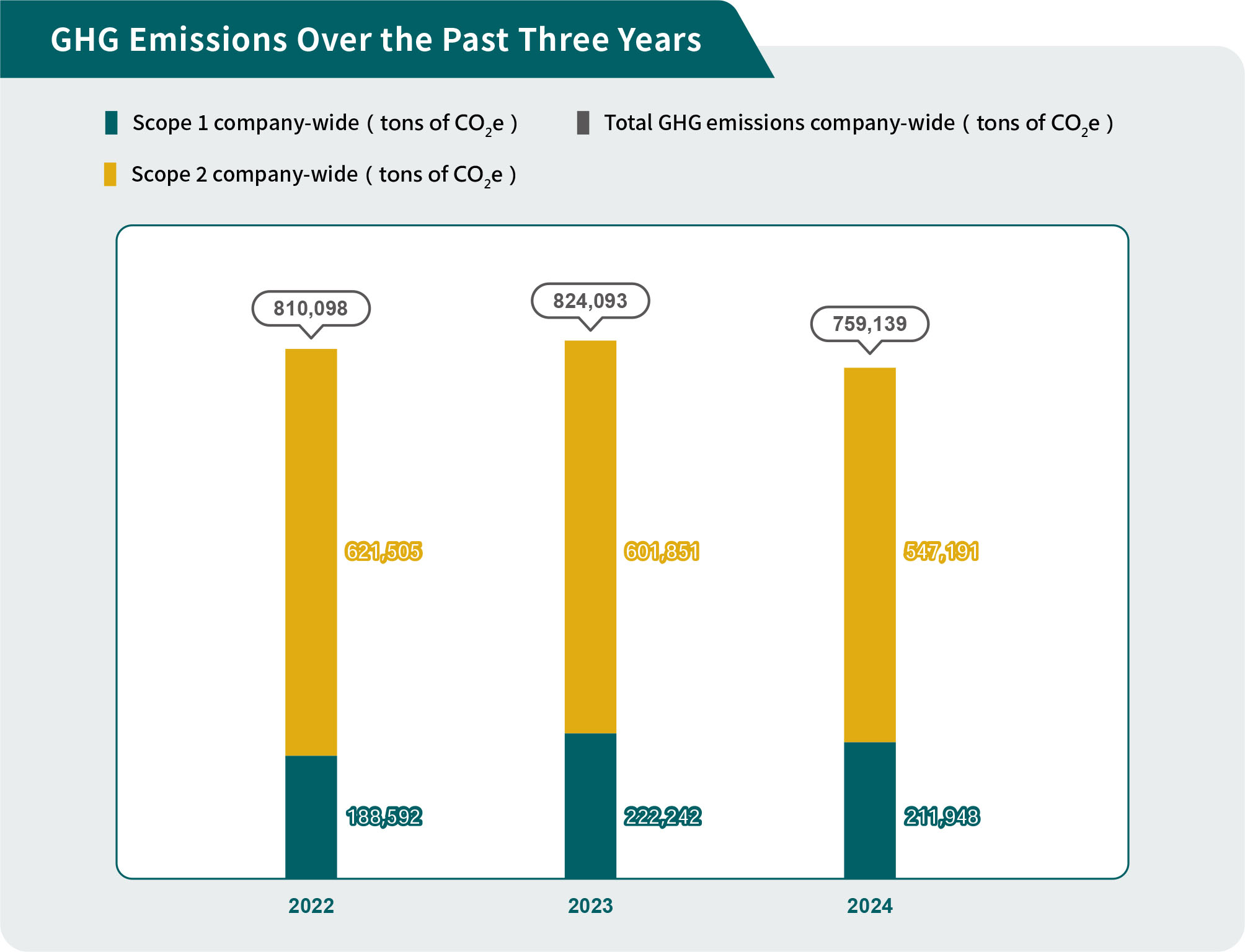
2025 Company-wide Proportion of GHG by Category
-
Unit: tons of CO2e Scope Category Description Emission Scope 1 Category 1 Direct GHG emissions 207,018 Scope 2 Category 2 Energy input 436,136 Scope 3 Category 3 Transportation 175,125 Category 4 Products purchased by the reporting company 1,231,898 Category 5 Use of sold products from the company 113,102 Category 6 Others - Total 2,163,279 -
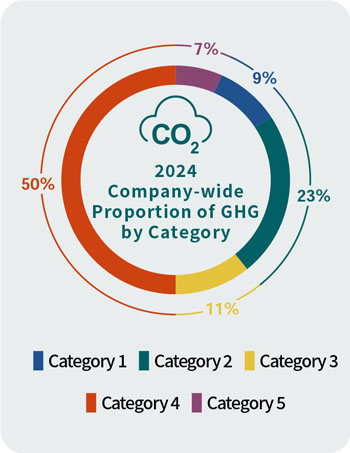
1. The GHG inventory of our three works and the Head Office was conducted in accordance with ISO 14064-1 procedures and also passed the external verification by a third party. The method used to consolidate the amount of GHG emissions: operational control approach.
2. Scope of GHG inventory: Head Office, Taoyuan Works, Miaoli Works, and Kaohsiung Works, Taoyuan Fabrication Center, and Taichung Harbor Logistics Office.
3. Uncertain assessment of GHG emissions referred to the table of GHG emission coefficient management v. 6.0.4 released by Ministry of Environment and the Technical Specifications for Calibration and Inspection of Measuring Instrument.
4. Power coefficient was calculated with 0.466 kgCO2e / kWh in Scope 2 and that of Scope 3 was calculated using the Simapro database. The GWP used in the reports is the "IPCC Sixth Assessment Report (2021) version.
5. Types of greenhouse gases include carbon dioxide (CO2), methane (CH4), nitrous oxide (N2O), hydrofluorocarbons (HFCs), perfluorocarbons (PFCs), sulfur hexafluoride (SF6), nitrogen trifluoride (NF3) and so on.
6. Standards, methodology, assumptions and/or other calculation tools used: The energy consumption amount all came from estimates in the receipts or the monthly natural gas consumption statement and material sheet & AS400/ checklist of changes in material inventories by material part number, and there were no estimated values.
Water Resources Management
In the face of global warming and global climate change, Taiwan has experienced extreme climate in recent years, and the wet and dry periods are becoming more serious, leading to increased risk of water shortage. Therefore, we respond to the national water policy and reduce emissions, save water and increase the cooling water recycling rate. Our three works are located in Guanyin District in Taoyuan, Xihu Township in Miaoli County, and Kaohsiung Linhai Industrial Park. According to World Resources Institute’s (WRI) Aqueduct Water Risk Atlas, the water stress level of the regions our works are located in belong to “Low - Medium risk (1-2)”. The water resource of the Company’s business locations is mainly from tap water (sourced from reservoirs in different regions).
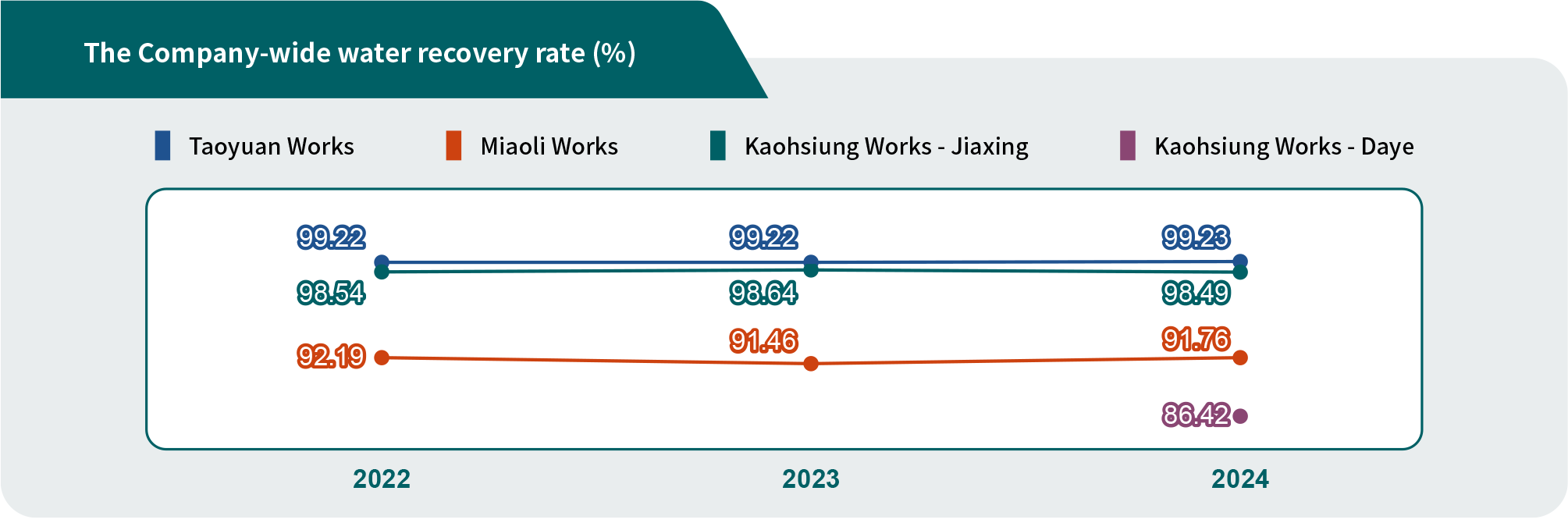
In 2025, the total water intake amounted to 2,161.253 million liters (tap water: 1,239.111 million liters, underground well water: 879.042 million liters, and rainwater: 43.1 million liters), and the water discharged amounted to 93.487 million liters, with the total water consumption reaching 2,067.766 million liters. In addition, the process water is recycled and reused after sedimentation. Among them, water recovery rate of Taoyuan Works was even as high as 99.37%.
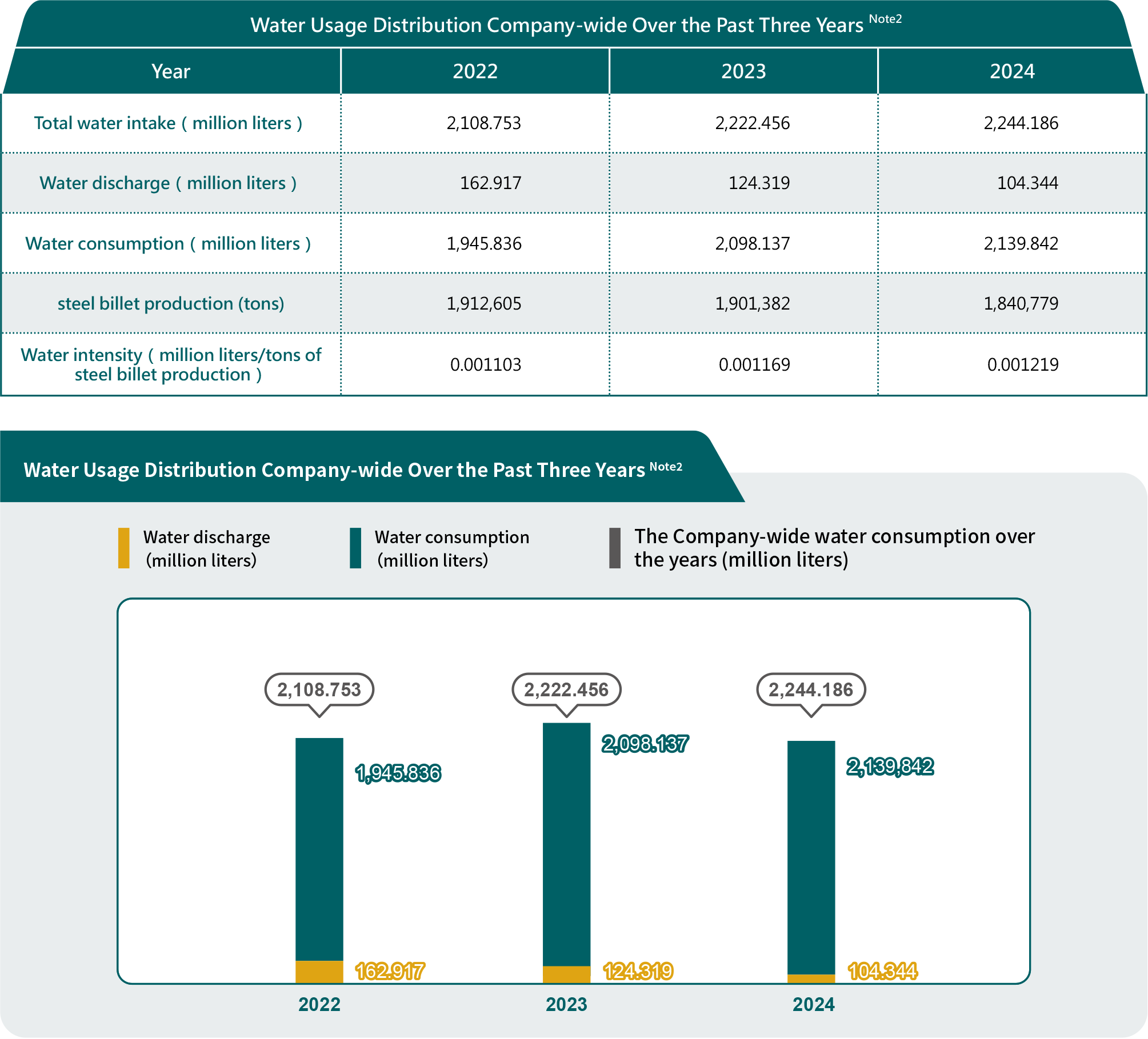
1. Water consumption = Water withdrawal (water usage) - Wastewater discharge.
2. Scope of water usage distribution calculation: Head Office, Taoyuan Works, Miaoli Works, and Kaohsiung Works.
3. The tap water consumption was actual measured values and could be supported by water bills. Rainwater recovery of Taoyuan Works was an estimate value, and rainwater and underground well water of Miaoli Works were from the record of water meters.
4. Discharge volume is based on discharge water meter. The discharge volume of Miaoli Works, Kaohsiung Works include domestic sewage.
5. Unit conversion: One million liters is equivalent to one thousand cubic meters.
6. Total water withdrawal= Tap water intake + Rainwater harvesting + Groundwater (well water) extraction.
7. The water intake data have been revised to correct a previously reported error.
Water Management Strategies and Reduction Targets
Tung Ho Steel attaches great importance to water resources and continues to work on various water saving measures. In addition to the adoption of the Best Available Technology(BAT) and the direct hot-rolled steel process in Taoyuan Works to effectively reduce the unit water consumption, industrial water (cooling water and process water) is reused with the adoption of a circulation design for the circulation and use of cooling water, soft water, and process water for repeatedly use, and the recycled water will be reused until the water quality cannot be used anymore and then will be discharged to the recycling pool for secondary use to reduce the need for external supplementary water for the implementation of effective use of water resources. For example, process drainage and domestic sewage are collected in the recycling pool after properly treated to provide secondary water as non-drinkable water or for other uses not involving human body contact from the claimed water pipeline or for direct use. The uses of secondary water include green land irrigation, sprinkling in storage area, cooling water for slag, refilling water for the landscape pond, road dust prevention and washing cars to reduce the overall water consumption.
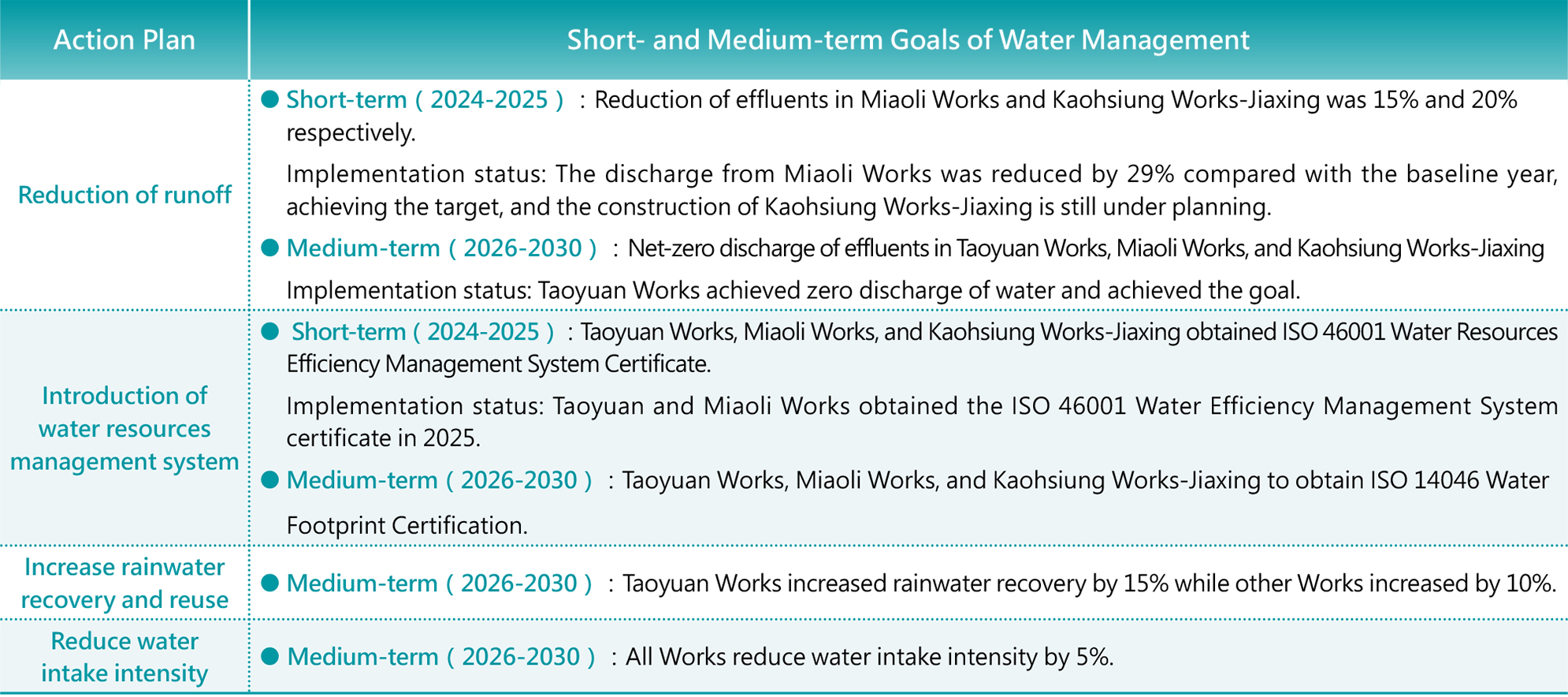
The Company attaches great importance to water resources management and has set water management strategies and short- and medium-term reduction targets in 2024. Taking 2023 as the base year, the action plan includes reduction of discharged water, introduction of a water resource management system, increased rainwater recycling and reuse, and reduction in water withdrawal intensity, so as to lower the consumption and waste of water resources and reach sustainable use of water resources. The Company received a B-level rating in 2025 CDP Water Security Questionnaire, showing that it has entered the water resources management stage and taken integrated actions on water-related issues.