

Friendly Workplace


Workplace Diversity and Human Rights Policy
Tung Ho Steel respects and supports the internationally recognized human rights norms and principles, including the "Universal Declaration of Human Rights", "United Nations Global Covenant", and the International Labor Organization's "Declaration on Fundamental Principles and Rights at Work". We abide by the laws and regulations of the place where the Company is located and have established Workplace Diversity and Human Rights Policy in accordance with the UN Guiding Principles (UNGPs) on Business and Human Rights. The scope of this policy also applies to the Company’s subsidiaries, foundations whose cumulative direct or indirect donations exceed 50%, and other group companies and organizations such as institutions or legal persons that we have substantial control over.
In response to the growing emphasis on gender equality, the Company launched the "Workplace Unlawful Harassment and Sexual Harassment Prevention Training Course" in 2025 and designated it as a mandatory course for managers at the section chief level and above. A total of 157 employees participated in the training, with 471 total training hours recorded.
| Workplace Diversity and Human Rights Policy |
|---|
|
1. Diversity, Inclusion, and Equal Opportunity
|
|
2. Safe and Healthy Work Environment
|
|
3. Freedom of Assembly
|
Compensation Policy
| Compensation Policy |
|---|
|
1. Employees remuneration policy
|
|
2. Managers remuneration policy
|
|
3. Directors remuneration policy
|
|
4. Independent Director remuneration policy
|
Management Regulations for ESG-related Incentive Pay to Senior Management
To encourage senior executives to actively participate in and promote ESG goals, enhancing the company's sustainable competitiveness, we have formulated the “Management Regulations for ESG-related Incentive Pay to Senior Management”. Assessment criteria include the proportion of renewable energy use (30%), absolute carbon reduction targets (30%), direct carbon intensity (5%), environmental fines at plant sites (5%), significant occupational accidents (5%), injury incidents (5%), corporate governance evaluations (20%), and other short- to medium-term goals. ESG bonuses are awarded based on the department's performance and alignment with these criteria. The scheme was approved by the 5th session of the 6th Compensation and Nomination Committee on May 14, 2024, and by the 9th session of the 25th Board of Directors on May 24, 2024.

Distribution of Employees
To establish a harmonious, friendly, and healthy working environment, Tung Ho Steel hires employees in accordance with Labor Standards Act, Act of Gender Equality in Employment and Occupational Safety and Health Act. However, due to the characteristics of the iron and steel industry, there are more male employees, and the gap between the number of male and female employees is large.
As of the end of 2025, the total number of employees in Tung Ho Steel was 2,147 (1,964 males and 183 females), including 1,849 full-time employees and 298 male temporary employees Note 1). The Company hired 62 indigenous employees (accounting for 2.89%) and 23 employees with disabilities (accounting for 1.07%) Note 2, higher than the 1% standard of the government’s employment quota prescribed in the People with Disabilities Rights Protection Act. All employees are full-time employees, and senior management Note 3 are 100% Taiwanese nationals. In addition, there were 5 staff members without guaranteed working hours and 298 non-employee workers Note 4.
1. Temporary employees refer to specific contract personnel, mainly foreign workers.
2. Indigenous people account for 2.89% of the total number of employees, and the job categories include department supervisors and other personnel. Employees with disabilities account for 1.07% of the total number of employees, and their job categories include senior executives, department supervisors, and other personnel.
3. High-level management refers to management positions including the president, senior Vice President, vice president, assistant manager and factory director.
4. Non-employee workers refer to contractors, whose main work is rebar processing.
5. The main work of the Company is all conducted by the employees hired by the Company, and there is no dispatched manpower and does not include board members.
6. The employee statistics mentioned above are from the HR system, and there are no numerical assumptions.
7. Local places refer to Taiwan region, and the major operating bases include the Head Office, Taoyuan Works, Miaoli Works, Kaohsiung Works, Taoyuan Fabrication Center, and Taichung Harbor Logistics Office.

Labor-Management Communication

The Company does not hinder the right to freedom of association. Except for the Kaohsiung Works-Daye, enterprise unions have been established in all operating bases, with labor-management meetings being regularly held. Trade union members can elect labor representatives to participate in labor-management meetings for labor-management communication, coordination of labor-management relations and promotion of labor-management cooperation. In 2025, more than 99.8% of employees in the Company joined the trade union.
To maintain stable labor relations, promote labor-management harmony, and enhance labor welfare, the Company started a collective agreement negotiation meeting with the enterprise union in Miaoli Works in September, 2023 in accordance with the Collective Agreement Act, discussing matters concerning labor conditions, welfare measures, occupational safety, employee grievance systems, labor union organization operations, and the use of enterprise facilities. After six negotiation meetings, the two parties signed a collective agreement on May 8, 2024. The validity period of the collective agreement was from the signing date till May 7, 2027, with a period of 3 years.
The Company has set up the Employee Welfare Committee and the Supervisory Committee of Workers' Retirement Fund, both of which have representatives elected by the enterprise union to serve as the committee members to supervise and protect the employees’ rights and interests.
Implementation of the "Zero Placement Fee" Policy for Foreign Employees
The Company obtained the Steel Sustainability Australia (SSA) certification in 2025, incorporating human rights protection and sustainability concept into the supply chain management mechanism. To prevent modern slavery and forced labor and to safeguard foreign workers' labor rights, we have gradually implemented the "Zero Placement Fee" Policy since 2025. During the initial phase, the Company assumes full responsibility for the monthly service fees payable by foreign employees to the employment agency, helping them alleviate their financial burden and enabling them to work and live in Taiwan with peace of mind. This initiative reflects the Company′s dedication to the UN′s Sustainable Development Goals (SDGs), particularly to Reduced Inequalities and Peace and Justice, fulfilling our commitment to protecting human rights.
| Timeline for "Zero Placement Fee" Policy Implementation | |||
|---|---|---|---|
| Implementation Phase | Implementation Period | Applicable Targets | Description of Policy Content |
| Current Measures | 2025 | All foreign employees | The Company covers the monthly domestic agency service fees payable to the employment agency, helping them work and live with greater peace of mind. |
| Medium-Term Plan | It is estimated to start in 2027 | New foreign employees | The Company covers the employment agency fees incurred before newly hired foreign employees arrive in Taiwan, helping them reduce the financial burden associated with the initial stage of employment. |
| All foreign employees | The Company plans to expand its coverage of essential employment-related expenses for foreign employees during their employment in Taiwan, including domestic agency service fees, medical examination costs, and work permit and documentation fees to strengthen employment protection for foreign employees. | ||
Employee Satisfaction Survey
To create a friendly workplace and strengthen labor-management communication channels, the Company carried out its Employee Satisfaction Survey for the first time in 2025. The survey was administered online using a five-point scale, covering six aspects, including work support, learning and development, leadership and management, collaboration and communication, job satisfaction and stability, and employee engagement and retention intention. A total of 400 copies of questionnaires were distributed between October 23 and November 14, 2025, and 280 were returned, with a return rate of 70%. The survey results indicated a high level of employee satisfaction overall, with the average score of over 4 points across all six aspects. Among them, “work support” and “employee engagement and retention intention” scored the highest. We will continue to organize workplace communication and coordination courses and increase diverse learning channels to build harmonious labor-management relations.
Employee Benefits
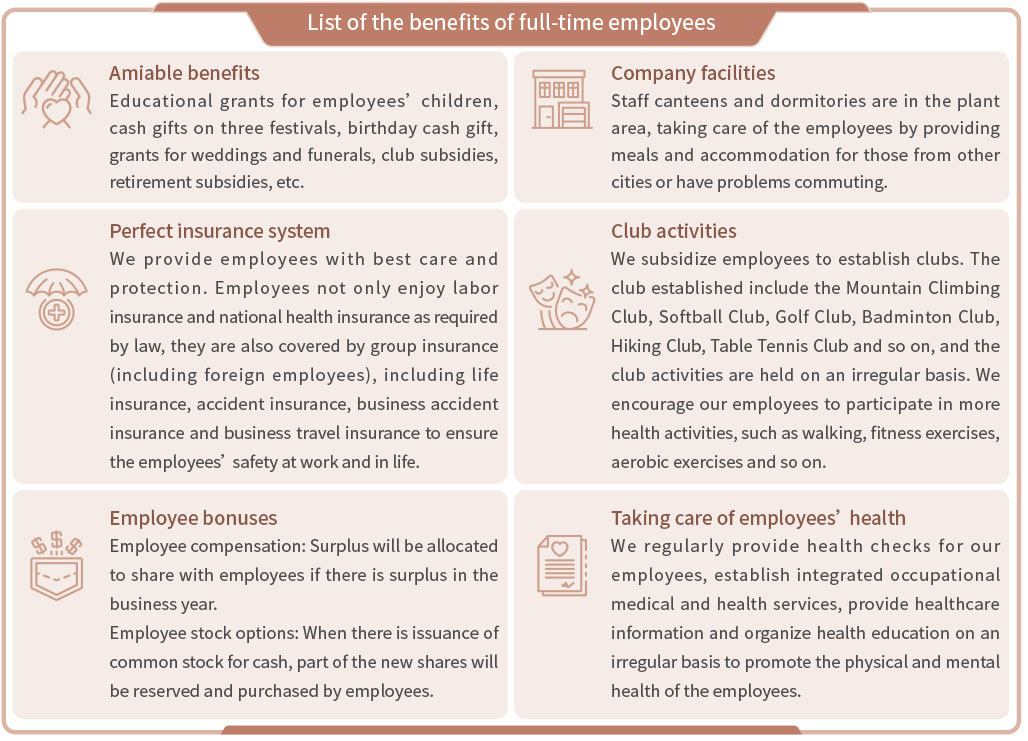
Tung Ho Steel regards employees as the most important assets of the Company. In order to take full care of the employees and provide great working conditions to satisfy employees’ needs, we not only provide basic protection in accordance with legal requirements but also specifically provide or sponsor the promotion of welfare programs with establishment of the Joint Employee Welfare Committee among the major operating bases (including the Head Office, Taoyuan Works, Miaoli Works, Kaohsiung Works, Taoyuan Fabrication Center, and Taichung Harbor Logistics Office) to organize various employee welfare activities and subsidies.

Talent Cultivation
To stimulate the potential of our employees and enhance their professional capabilities, we have provided diverse learning resources and channels, including the orientation training for new recruits, technical and professional training for various functions, management training for supervisors at all levels, and general education courses like languages and courses in arts and humanities. It is hoped that all employees can be in appropriate job fit through a complete education and training system to enrich the human resources of the Company. To encourage our employees to continue on-the-job learning to obtain more knowledge and skills, the costs for participating in education and training at home and abroad of the employees are 100% covered by the Company in accordance with the Education and Training Regulations. If the education and training courses are held beyond normal working hours, the employees can apply for overtime or switch shifts as prescribed.
For unfit employees, the Company has set up relevant measures for performance improvement. The supervisors assist the employees to jointly establish the improvement plans and take corresponding measures, and three to six months will be provided for improvement. We aim at achieving the purpose of enabling employees to be in appropriate job fit.


Retirement System
The Company has set up the pension plan for the employees in accordance with the Labor Standard Act and Labor Pension Act and has approved the establishment of the Supervisory Committee of Labor Retirement Reserve. Actuarial calculation of the labor pensions of the old system is made year by year ( from 2015 to 2017 the allocation rate was 7%, and starting from 2018, the allocation rate was adjusted to 10%), and a meeting is convened regularly to protect the employees’ rights and interests. As of the end of 2024, the pension reserve has been sufficient to cover the pension of employees who are qualified for retirement in a year. A 6% of monthly contribution to the individual pension account in accordance with the Monthly Contribution Classification Table is made for employees eligible for the new pension system, and the voluntary contribution percentage ranges from 0%~6%.
